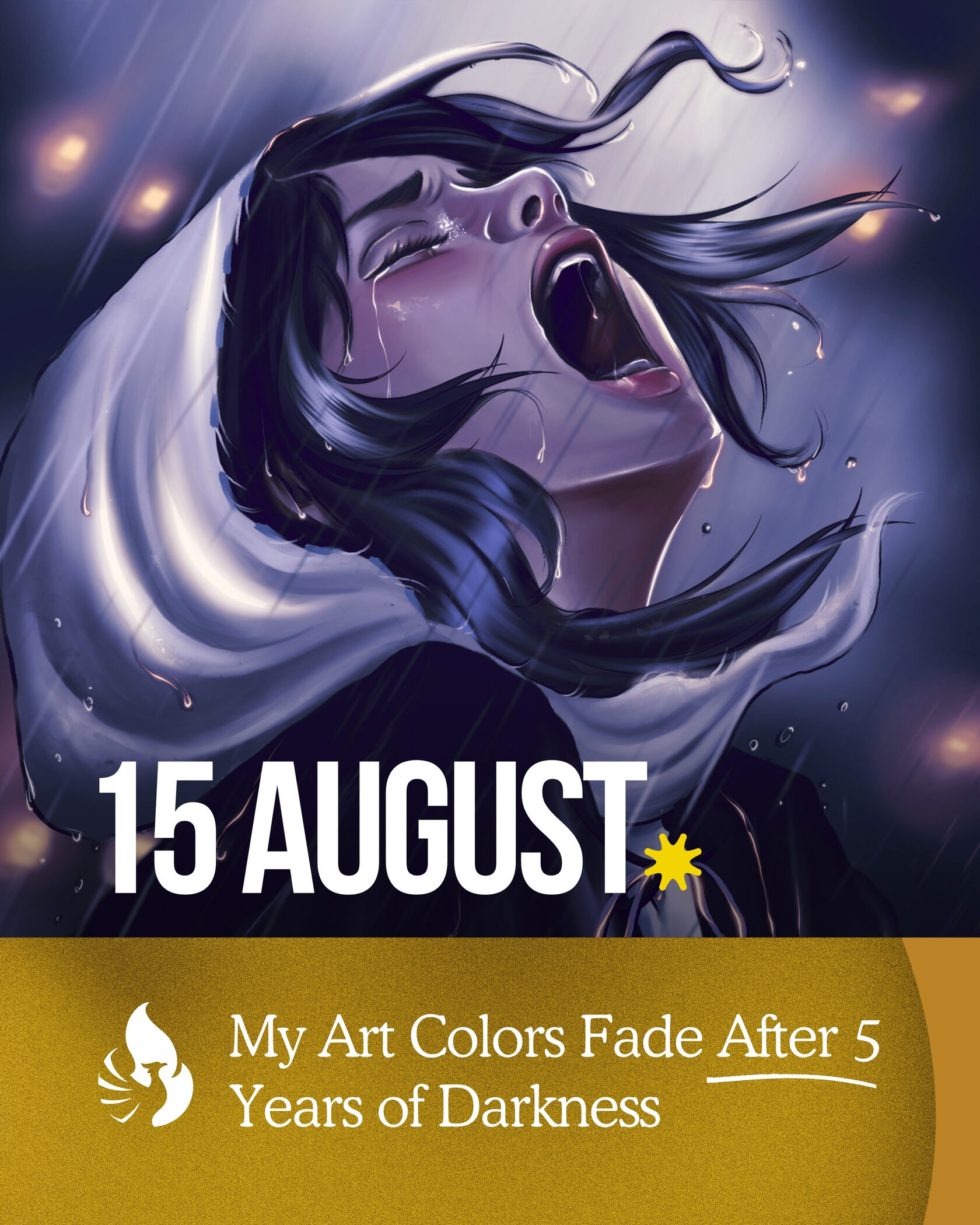
AFGHANISTAN | FIVE YEARS ON 15 AUGUST 2026
My Art Colors Fade After 5 Years of Darkness
An artist resisting extremism through her work, five years after the Taliban’s return to power
People outside Afghanistan may pause, listen and feel sorrow before carrying on with their lives. For women inside the country, there is no moving on. Mahsa is one of them. After five years of Taliban rule, she says even her art has lost its bright colours.
When the Taliban returned to power in Afghanistan on 15 August 2021, many artists, doctors, writers and other professionals fled the country. Their departure dealt a devastating blow to a society with a long tradition of art, literature and intellectual life.
Mahsa, however, remained in Kabul. Through her paintings, she gives form to the silenced voices of Afghan women and girls living under severe restrictions. Her work portrays their confinement, grief and struggle, and calls the world’s attention to the denial of their fundamental rights.
For security reasons, “Mahsa” is a pseudonym. Details that could reveal her identity or place of birth have also been withheld.
Five years after the Taliban’s return, this interview forms part of WFA’s coverage of the lives, resistance and aspirations of Afghan women.
WFA: Thank you for speaking with us. Could you tell us about yourself and how art became part of your life?
Mahsa: Thank you. My name is Mahsa, but because I am still in Afghanistan and face threats, please do not publish my surname or birthplace. I was born in 1998 and graduated in graphic design from the Faculty of Fine Arts.
If I had to explain why I chose painting in one word, I would say “passion.” Art has been part of my life for as long as I can remember. My love for it grew so quickly that I could never separate it from my life.
My talent became more apparent during my teenage years. Later, I learned to transform what I saw, heard and read about the world around me into art. I realised that difficult issues can sometimes be expressed more powerfully through images.
WFA: What does art mean to you, and what do you want your own work to say?
Mahsa: Every form of art has its own influence. A poet expresses an idea through poetry, a singer through music and a painter through colour. Art touches the human spirit. It can free people, even briefly, from the conditions surrounding them and give them emotional and spiritual strength.
I have been involved with art for as long as I have understood the difference between good and bad. Painting gives me peace. It strengthens me and helps me see the beauty that still exists in life.
From everything I have learned through my education and experience, I believe a powerful artist is someone who can affect society and communicate an idea clearly.
Given the conditions in my country and the terrible situation facing its women and girls, I want my art to become their voice. But with each passing year, we have become more hopeless. Now, as we reach the fifth year, my art has lost its bright colours. The same loss of colour can be seen in every part of the lives of women and girls in Afghanistan.
WFA: Why do you think the Taliban have barred girls from education, and what do you still hope for after five years?
Mahsa: I do not want to repeat clichés, and I do not claim to understand politics. I only know that the Taliban have deprived women of their basic human rights simply because they are women.
I hope that women’s movements for freedom, whatever form they take, will become a light in the darkness and revive the hopes that have been lost. My greatest wish is to see the women and girls of my country freed from confinement.
Some of my paintings, which portray parts of the tragedy facing Afghan women, have been shown alongside the work of prominent international artists and displayed by international organisations. Because of threats from the Taliban, however, I could not exhibit these works under my real name.
I dream of the day when my art can be displayed under my own name in major international institutions and alongside the work of leading artists. I want it to become a source of pride for my country.
WFA: What message would you like to send to women around the world?
Mahsa: I ask women around the world to use every means available to amplify the silenced voices of Afghan women living under oppression. The international community must be pressed to act and help end the suffering of women in Afghanistan.
Five years later
The restrictions Mahsa drew during the Taliban’s first year have since hardened into a system. UN Women reported in August 2026 that the de facto authorities had issued more than 100 decrees affecting women and girls since taking power. The rules reach into education, employment, healthcare, justice, freedom of movement and family life.
The consequences are visible in women’s daily routines. Based on surveys and interviews with more than 5,000 people conducted in 2025 and 2026, UN Women found that more than half of the women surveyed left home no more than twice a month. Nine in ten said they needed permission from a male relative to go out, while seven in ten described their mental health as bad or very bad.
Education remains the clearest measure of the reversal. UNESCO estimated that 2.4 million Afghan girls had been excluded from secondary education by 2026. Women have also been barred from universities since December 2022. Afghanistan remains the only country in the world where girls and women are formally prohibited from secondary and higher education.
The damage will extend beyond the students who are currently shut out. An April 2026 UNICEF analysis warned that, if the restrictions continue, Afghanistan could lose up to 20,000 women teachers and 5,400 women healthcare workers by 2030. With fewer women trained to teach and provide medical care, today’s bans are also narrowing the choices available to the next generation.
Taliban authorities reject international assessments of their record and say they protect women’s rights according to their interpretation of Islamic law and Afghan culture. The prohibitions on secondary and university education remain in force, however, and United Nations agencies say that the wider restrictions on women’s lives have continued to expand.
Sources
UNICEF, 10 August 2022. “Our situation is like sad music that plays for a moment”
UN Women, 12 August 2026. FAQs: What it is like to be a woman in Afghanistan today
UNESCO, 14 August 2026. Five years on: Keeping learning alive for girls and women in Afghanistan
UNICEF, 28 April 2026. Restrictions could cost Afghanistan more than 25,000 women teachers and healthcare workers
Reuters, 11 August 2026. Taliban have barred 2.4 million Afghan girls from school since 2021, UNESCO says